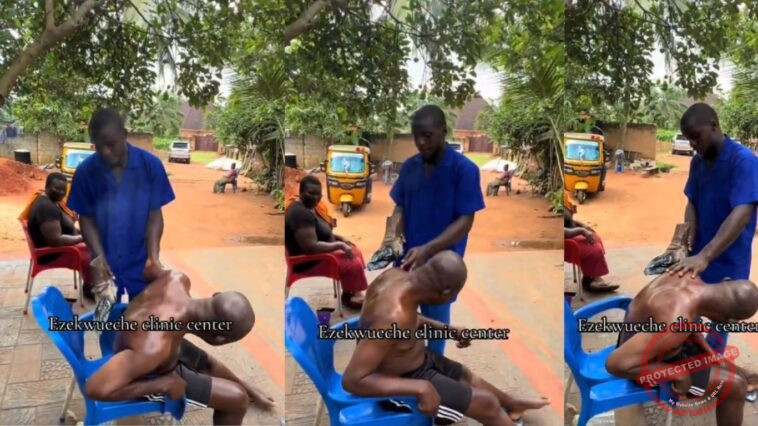
A controversial video showing a traditional practitioner applying intense heat to a man identified as a stroke patient has gone viral on social media, triggering strong reactions from doctors and health professionals who warn that the practice is dangerous and has no established scientific evidence as a cure for stroke.
The video, reportedly recorded at Ezekwueche Clinic Center in a rural Nigerian setting, shows a shirtless man undergoing what appears to be an intense heat-based treatment. The practitioner applies a heated cloth or fire-related instrument to areas including the man’s back, neck, spine and limbs.
The patient appears uncomfortable during the procedure, at times grimacing and recoiling from the heat.
The footage was shared on X alongside a claim that Africans use fire to “permanently cure stroke.” It reportedly attracted more than 1.4 million views within hours, generating a heated online debate over traditional medicine, alternative treatments and the dangers of delaying hospital care.
Popular Nigerian doctor and health educator Aproko Doctor was among those who criticised the treatment, describing the practice as “plain wickedness.”
He explained that stroke is a medical emergency that occurs when blood supply to part of the brain is interrupted or when a blood vessel in the brain ruptures.
According to the doctor, the appropriate response to a suspected stroke is urgent medical assessment, brain imaging and appropriate treatment—not the application of fire or extreme heat to the patient’s body.
Other doctors also expressed concern over the video, warning that exposing a vulnerable patient to intense heat could result in burns and other complications while creating a potentially dangerous delay in receiving emergency medical treatment.
The controversy has also prompted renewed discussion about the role of traditional healers in communities where access to hospitals, specialist doctors and diagnostic facilities remains limited.
Some social media users defended the practice, citing traditional beliefs and personal experiences involving relatives who they claimed improved after undergoing similar treatments.
The original poster also shared what was described as BBC Pidgin coverage of the practitioner, who reportedly believes that stroke can have both medical and spiritual dimensions.
However, medical professionals have stressed that personal testimonials do not establish that a treatment is effective or safe.
A stroke occurs when the blood supply to part of the brain is blocked, usually by a clot, or when a blood vessel in the brain ruptures.
When brain tissue is deprived of oxygen and nutrients, damage can occur rapidly. This is why doctors frequently stress that time is critical when treating stroke.
The first priority is to get a suspected stroke patient to an appropriate medical facility as quickly as possible.
Doctors may use brain imaging, such as a CT scan or MRI, to determine what type of stroke has occurred and guide treatment.
For some patients experiencing an ischemic stroke, clot-dissolving medication may be appropriate if they reach medical care within the required treatment window. Some patients with certain large-vessel blockages may also qualify for mechanical thrombectomy, a procedure used to remove the clot.
These treatments require professional assessment and cannot safely be replaced by unproven home or traditional procedures.
While heat may have limited applications in rehabilitation for certain muscle or joint problems, medical experts distinguish such controlled therapeutic uses from the application of intense heat or fire to a person experiencing an acute stroke.
There is no established evidence that applying fire or extreme external heat to the body can reverse the underlying brain injury caused by a stroke.
Doctors are particularly concerned when such claims are presented as a permanent cure, because they may encourage patients or their families to postpone emergency treatment.
A person suffering a stroke may not immediately know whether the condition is caused by a blood clot or bleeding in the brain. The distinction is crucial because treatments suitable for one type of stroke can be inappropriate or harmful in another.
That determination requires medical evaluation and brain imaging.
Health professionals say the biggest danger posed by unproven stroke treatments may not only be the treatment itself but also the time lost before a patient reaches a hospital.
Stroke symptoms can include sudden weakness or numbness, particularly on one side of the body, facial drooping, difficulty speaking or understanding speech, sudden problems with vision, dizziness and loss of balance.
When such symptoms appear, doctors recommend seeking emergency medical care immediately.
Families are also urged not to wait for symptoms to disappear or rely solely on traditional remedies before seeking professional medical attention.
The widespread reaction to the video reflects a broader debate in Nigeria and other African countries over the relationship between traditional healing and modern medicine.
Traditional healers remain important to many communities, particularly in areas where healthcare facilities may be distant, expensive or difficult to access.
Medical professionals, however, say traditional practices should not be promoted as replacements for emergency treatment when dealing with potentially life-threatening conditions such as stroke.
They argue that cultural beliefs and medical care can only coexist safely when patients are not discouraged from seeking appropriate diagnosis and treatment.
As the video continues to circulate online, doctors are urging social media users to avoid sharing unverified claims about stroke cures and to recognise the warning signs of the condition.
 Shola Akinyele












 and then
  WhatsApp us
Comments