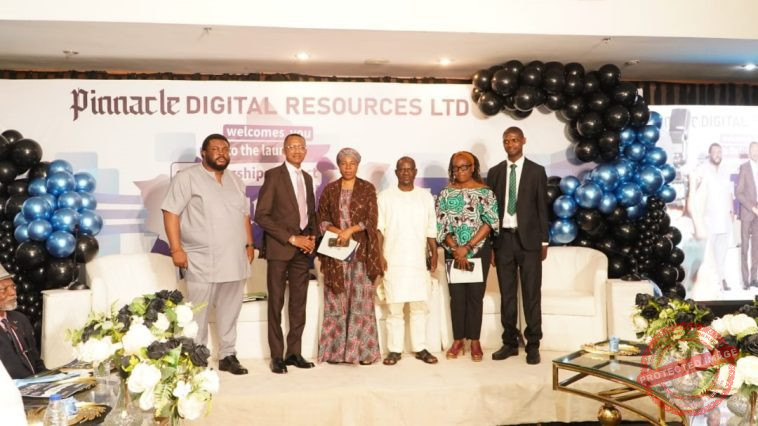
The Nigeria media welcomed a brilliant addition on Wednesday, October 15, 2025, when Pinnacle Daily was officially presented to the public in Abuja.
Abimbola Adeseyoju, chairman of Pinnacle Digital Resources Limited, revealed that the idea of the online daily started about three years ago. “We wanted to be forever relevant in the lives and decision-making processes of the new generation of media consumers. Call them Gen Z or Gen Alpha. What matters most is that what they are looking for in a piece of news is different from what the older generation is looking for.”
He recalled, “The most difficult item for those of us who grew up in the 70s, 80s and up till the 90s was sourcing knowledge. Today, knowledge is within our palms, and it is (substantially) absolutely free. So, the problem confronting this new generation is not about knowledge. It is about choices. How to make the best decisions from the avalanche of news and information available on employment, careers, health, education, leisure, entertainment, finance, business opportunities, wealth creation and many more.”
Pinnacle Daily, he affirmed, “want to be the trusted channel of choice for this generation when it comes to decision-making in their personal, economic and political lives. We want to be able to provide needed rational and advantageous information to our consumers so they can win in life. This is our promise. And this we will keep,”
In a keynote address, “The Economics of Media Business: Understanding Revenue Models and Profitability”, Isiaq Ajibola, co-founder and former managing director of Daily Trust newspaper, noted that technology has drastically changed the media environment and business today. This development necessitates innovative strategies to generate revenue.
“It has become necessary for everyone in the media to evolve or risk going to oblivion. The shift from print to digital has transformed the traditional media business model. Yet, it has also opened new revenue opportunities,” he argued.
Some of these revenue models that digital media platforms can adopt to survive include digital advertising based on demographics, interests, and browsing history; sponsored content; subscription and premium content; brand partnerships; events and conferences.
Six panelists discussed Ajibola’s paper with emphasis on innovative revenue models. The session, which was moderated by Adedeji Adekunle, Programme Director, West and East Africa, MDIF, had the following as panelists: Azu Ishiekwene, Editor-in-Chief, Leadership Media Group; Musikilu Mojeed, Editor-in-Chief, Premium Times; Simon Kolawole, Founder and CEO, The Cable newspapers; Zainab Okino, former Kogi State Commissioner for Information; and Angela Agoawike, Founder and Principal Partner, Omalicha Media Network.
Azubuike Ishiekwene, advised media organisations to innovate, invest in talent and leverage on data to tell their stories to attract readers and remain profitable.
He said editors should monitor their websites’ algorithms, which are controlled by big technology companies; “Google controls at least 90 percent of our searches, followed by Bing. They determine how much visibility and revenue we get. Online platforms are not as viable for news consumption as social networks. Media owners must take social media seriously because it influences how audiences consume content.”
He further advised, “It’s important for us to pay attention to data and also what the data is telling us, both in terms of how we build our content and how we engage with readers and audiences. Having a platform is one thing but dealing with the algorithms that determine the kind of revenue you get is entirely a different subject.”
Ishiekwene urged mediapreneurs to build sustainable media models, invest in talent, adopt flexible leadership, and leverage data to guide operations. “One of the key challenges we all face as media people is finding talents that can help us build a business model. Another challenge is our editorial culture. Until we begin to change our mindsets and build a culture that resonates with the changing times, we’ll continue to struggle.”
He admonished old newsrooms where editors resist innovation. “You have dinosaurs managing what is essentially a process of change. Unless you change the mindset of those leading your teams, progress will remain difficult.” He called for teamwork, creativity and openness to new tools.
Zainab Okino, chairperson of Blueprint Newspaper Editorial Board, advised that media must evolve to remain afloat in the market. “Media organisations must adopt evolution and become digital as the media space continues to change. The way an organisation starts, especially the kind of people it employs, determines its growth. Human resources are at the core of every sustainable newsroom.”
This agrees with Adeseyoju’s advice for media houses to “focus on the consumers and not the technology. Technology is just a tool,” he argues. “What we need to keep understanding is the needs, peculiarities and preferences of the consumers of our various news products and services.”
Mohammed Idris, minister of Information, represented by Dili Ezughah, executive secretary, Nigeria Press Council, said President Bola Tinubu’s administration is working with the press “to ensure democracy and aid in building a safe, sound and prosperous nation.”
He urged the media to be professional and always adhere to the ethics of the profession reflecting truth, fairness, justice, and social responsibility.
Olusegun Osoba, chairman of the occasion, represented by Eric Teniola, endorsed the arrival of Pinnacle Daily, which he said “comes at a time when the journalism profession and the media are going through very dramatic changes. As professionals, especially for the elders and leaders in the profession, the onus is on us to show the light and lead the way in the preservation of journalism practice and standards, a duty I want to remind us all that we must never shy away from.”
Musikilu Mojeed, reaffirmed that “great content is key to survival.” He advised media houses to go for quality stories that will attract and keep readers. He shared the Premium Times’ experience, explaining, “we were focused on content.”
However, he expressed the frustration of losing staff to foreign media after being trained due to better remuneration. He advised new publications to specialise in a core area and become an authority in that sector.
“You have to be different from the beginning. You must consistently keep being great content.”
He further noted that credibility is also important. Publications should be “factual, diligent and credible. No friends; no foes.”
Angela Agoawike emphasised entrepreneurship skills. “You can be a great journalist but a poor businessman. You should be able to pay salary to your staff.”
She re-emphasised credibility and independence. “You cannot police one who is giving you money. It takes time to succeed. You have to cover costs, pay your staff and running costs.”
Dayo Aiyetan, executive director of Pinnacle Resources Limited, in his vote of thanks, revealed that “Pinnacle has come a long way. It has been three years. This is a master class on how to run a successful business.”
He said the strength of the company is the staff. “Pinnacle, from the beginning, was blessed with the right staff.”

 Anayochukwu Agbo
75 Views
Anayochukwu Agbo
75 Views











 WhatsApp us