
 Anayochukwu Agbo
Follow
X
Follow
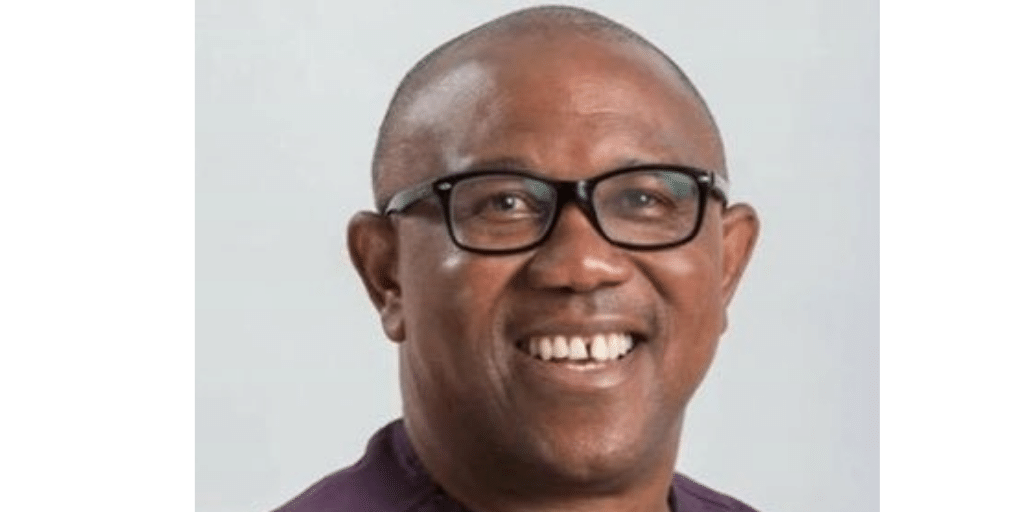
Peter Obi, Labour Party’s presidential candidate in the 2023 presidential election, brought the 2025 political calendar to a dramatic climax by officially declaring for the African Democratic Congress, ADC, at the ancient city of Enugu on December 31, 2025.
The move puts the intrigues surrounding Obi’s 2027 presidential ambition in Labour Party (LP) to an end and narrows the inter-party contest to probably three major parties – APC, PDP and ADC.
The exit of Obi from LP takes the substance off the party and back to the back waters of Nigeria politics where it hibernated before Obi’s entrance.
Putting behind the acrimony and intrigues behind, Obi declared: “This is the time for national unity and prosperity”
According to him, “The signs are clear, and the mission is settled. Having been part of the coalition from inception, I now respectfully call on my political leaders, associates, supporters, the Obidient Movement, political leaders and members of the opposition parties across the country to join this broad national coalition under the African Democratic Congress led by Sen. David Mark.
‘This decision is guided solely by patriotism and national interest. We are working with leaders across political divides who share a common commitment to rescuing Nigeria. The task ahead is enormous, but it is not insurmountable. History may forgive wrong decisions, but it will not forgive silence in moments of national peril.
“Do we deserve a government that thrives on division, propaganda and indifference to the suffering of its people? I do not believe so. Nigeria deserves patriotic leadership that unites and governs with empathy. Let history record that Nigeria’s turning point began here and now.
“Together, let us move forward with courage, unity and resolve. A new, united, productive and inclusive Nigeria is possible.”
He acknowledged the import of the moment. “As the year 2025 ends today, we stand on the threshold of a new year, which we hope will mark the beginning of Nigeria’s long-awaited socio economic transformation. For every nation, and people, moments of profound national challenge demand clarity of purpose, courage, and decisive action, for Nigeria, that moment is now!
“Many have said that Nigeria is an independent country in name, yet today we must begin a new struggle: the struggle for true independence based on self-determination, human equality, and national reunification. We must reclaim our country from a small group of opportunists who have captured the corridors of power and return it to its rightful owners – the Nigerian people!
“What is most painful is that many of those who once benefited from democratic governance have now become accessories to a stolen mandate, shamelessly celebrating electoral injustice in public, and working hard to destroy democracy through coercion, manipulation and outright gangsterism particularly on opposition parties. Let me assure Nigerians that we will defend our fragile democracy and make it resilient. We will decisively defeat any attempt by the ruling party and its agents to manipulate or rig future elections. The will of the Nigerian people is sacrosanct, non-negotiable and those plotting to subvert it in 2027 should rethink their actions. Nigerians have endured enough and will resist any assault on their mandate through all lawful and legitimate means.”
He summed up the institutional fragilities of Nigeria and called for urgent electoral reforms. “Because of weak national institutions, particularly the Independent National Electoral Commission (INEC), contributed significantly to our present crisis, we most strongly demand urgent reforms of the entire electoral process. We demand credible and transparent elections that are free and fair and based on strict adherence to electoral laws, starting with prescribed educational qualification for eligibility for election and transmission of results as voted. At the heart of our coming national transformation is electoral integrity which will promote responsive governance. We can no longer toy with electoral integrity especially as we see the tragedies of truncated democracies across West Africa. Nigeria is too big and important to the black race and the global economy to remain a failure. We must protect democracy in Nigeria by ensuring credible elections in 2027.”
Obi called the rethinking of Nigeria and the need for unity. “It is public knowledge that Nigeria is in grave distress. Our democracy is under threat. Our nation is adrift. Our people are in persistent agony. Today, Nigeria is widely described as a failing and disgraced nation. This is not the destiny that Almighty God bequeathed to over 220 million Nigerians. It was not always so and should not remain so. Across all recognized indicators of good governance – accountability, political stability, rule of law, control of corruption, government effectiveness, regulatory quality, and separation of powers – Nigeria records negative marks.
“With over 130 million Nigerians living in multidimensional poverty, more than 80 million youths unemployed, worsening insecurity, fiscal recklessness, disunity and the absence of inclusive governance, like many patriotic Nigerians, I am deeply disturbed by the state of our nation. The question on everyone’s lips is whether there is still hope for Nigeria. Despite the gravity of our situation, I remain firmly optimistic! Given our immense human and natural resources, I am convinced that a new Nigeria is possible—a functional, productive and inclusive nation.”
He said he was deeply desirous of a new order in Nigeria. “Motivated by my desperation for a New Nigeria That Is Possible, I am in constant search for possible solutions to make Nigeria work for all Nigerians, to make Nigeria an inclusive and progressively sustainable nation. While we are faced with litany of socio-economic problems, the absence of unity caused by dishonest, corrupt and ineffective leadership is at the heart of our problems.
“In addition to my various leadership training in many renowned institutions including Lagos Business School; Kellogg Graduate School of Management, Harvard, Oxford, and Cambridge universities; INSEAD; IMD and LSE, my desire to see a better and functional Nigeria has sustained my search for knowledge on leadership and nation building. All my readings and travels over many years have been primarily focused on understanding what promotes national unity and national transformation, and how to embed deep rooted unity and effective leadership in our dear nation, Nigeria. Let me mention few insights that are still very fresh in my mind.
“Having observed and read extensively on conflict, disunity, reconciliation, unity, and development, I travelled and met with one of the best authors, Professor Nicole Fox of California State University, who wrote on conflict, reconciliation, and the transformation of Rwanda. Her writings inspired in me a confidence that Nigeria can move from conflict and instability to consensus and rapid socio-economic transformation. To have a first-hand experience of how Rwanda was transformed, I travelled to Rwanda and had the opportunity of having a valuable time with President Paul Kagame to further learn from his experiences in the leadership of Rwanda. It has remained one of my most treasured learning experiences.
“In discussing and learning from President Kagame, I saw a leader deeply committed to the unity and socio-economic transformation of his country, evident in the growth of GDP per capita from about $200 in 1995 to over $1,000 in 2025—a phenomenal 500% increase. In comparison, Nigeria’s GDP per capita in 1995 was $1,225 and has lamentably declined to below $1,000 in 2025, a decline after 30 years of supposed nation-building in a country proudly called the “Giant of Africa.”
“Shocked by the gap in GDP per capita and other development indices between Nigeria and other emerging economies, I got curious to find out the reason for this divergence. This led me to read the book Growing Apart: Politics and Economic Change in Indonesia and Nigeria by Professor Peter Lewis of JohnsHopkins University. In this fascinating and deeply revealing book, Professor Lewis most convincingly showed how policy choices, state institutions, national unity, and leadership shape sustainable economic development or under development. While Nigeria and Indonesia had similar characteristics of high population, cultural heterogeneity, and agrarian economies, the current gap observable in almost all key socio-economic indicators can be attributed to the power of leadership and unity, and their utilisation for effective nation-building and socio-economic transformation.
“Disturbed by the insights from the book, I travelled to Johns Hopkins University and met Professor Peter Lewis. The meeting and learning were even more shocking than the revelations from the book. Following that, I travelled to Indonesia and had meetings with Ministers of Education, Planning, Health, Small Villages, Small Businesses, the Vice President, and one of their most popular leaders, President Joko Widodo, to learn more about how they achieved such significant success.
“While Indonesia has significantly transformed into a commendable success, with a GDP of above $1.4 trillion, the first in South-East Asia to cross the 1 trillion mark, and a per capita of about $5300, it is the largest economy in South-East Asia. On the contrary, with the GDP of $240 Billion and Per Capita of below $1000 our dear country Nigeria is experiencing socio-economic confusion, de-industrialisation, pervasive corruption, conflict, and increased poverty.
“In conclusion, Professor Lewis maintains that Indonesia achieved commendable progress largely due to how its leaders and government managed their resources, while Nigeria became more underdeveloped, fragmented, and poorer due to how we consumed and squandered our resources.











 WhatsApp us