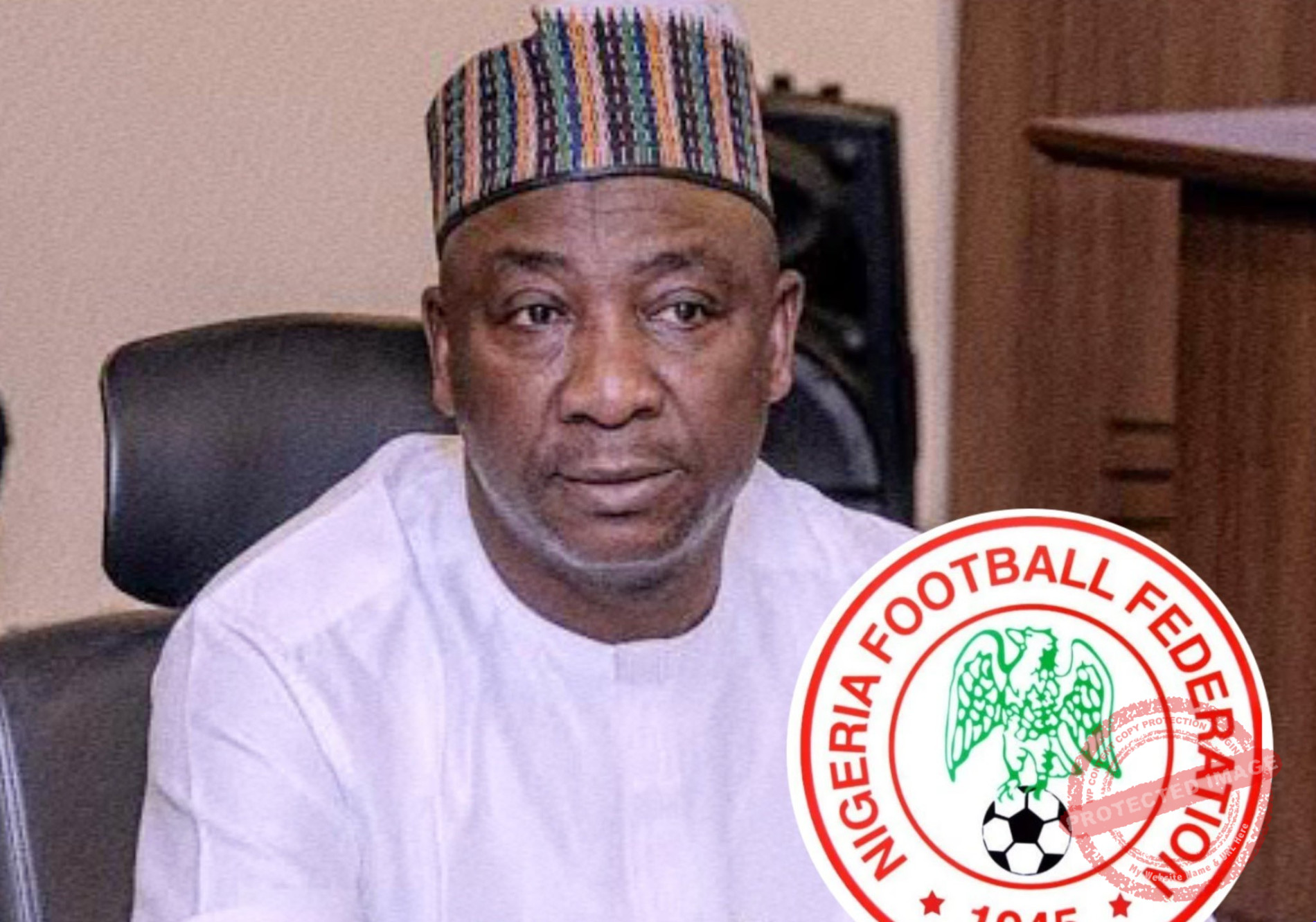
The Nigeria Football Federation (NFF) has been thrown into a fresh leadership crisis after its president, Ibrahim Musa Gusau, resigned from office alongside members of the federation’s Executive Committee and General Secretary, Dr Mohammed Sanusi.
Gusau announced his resignation on Thursday at the NFF’s Sunday Dankaro Secretariat in Abuja, bringing an abrupt end to his tenure at a time when Nigerian football is facing one of its most difficult periods in recent years.
The NFF subsequently confirmed the development, stating that Gusau, the Executive Committee and Sanusi had stepped down.
Gusau said he had informed members of the board of his decision and advised those who were willing to follow his lead to resign as well. He described the decision as being in the best interest of Nigerian football amid what he called an unprecedented crisis.
The resignations have created uncertainty around the NFF’s planned elective congress scheduled for September 27 in Lafia, Nasarawa State, with questions now being raised about how the federation will be administered ahead of the proposed elections.
The leadership shake-up follows a disastrous period for Nigeria’s national teams.
The Super Falcons suffered a historic setback after failing to qualify for the 2027 FIFA Women’s World Cup in Brazil. Nigeria had featured in every edition of the Women’s World Cup since the competition began in 1991, but that 35-year streak has now come to an end.
The Falcons’ campaign ended with a 1–0 quarter-final defeat to Cameroon at the 2026 Women’s Africa Cup of Nations, followed by a 2–1 loss to South Africa in the World Cup qualification play-off.
The result led to the dismissal of coach Justine Madugu and his technical crew and intensified criticism of the country’s football administration.
The Super Eagles had already suffered their own major disappointment after failing to qualify for the 2026 FIFA World Cup.
Nigeria’s hopes ended in the African play-off after the Super Eagles lost to the Democratic Republic of Congo on penalties. It means Nigeria will miss a second consecutive men’s World Cup after also failing to qualify for Qatar 2022.
The country’s youth teams have also struggled to maintain their traditional presence on the international stage.
The Flying Eagles lost 4–1 to Burkina Faso in the WAFU B U-20 final on August 9, a result that reportedly left Nigeria outside the qualification pathway for the 2027 U-20 Africa Cup of Nations and the 2027 FIFA U-20 World Cup under the current allocation.
The Golden Eaglets, five-time FIFA U-17 World Cup champions, have also endured a prolonged decline, having missed three successive editions of the global tournament after failing to qualify for the 2026 U-17 Africa Cup of Nations.
The combined failures have increased scrutiny of the NFF’s management of national teams, football development, administration and funding.
The federation had already commissioned a fact-finding committee to investigate some of the problems affecting Nigeria’s national teams.
The six-member committee, chaired by former Nigeria international and ambassador Fanny Amun, was inaugurated in August and given two weeks to complete its assignment. Its report, dated August 21, reportedly highlighted issues including difficulties at training camps, administrative weaknesses and shortcomings in player development.
Punch subsequently reported that the document contained allegations that some officials influenced invitations to national-team camps in exchange for money. The allegations remain allegations and have not, by themselves, established wrongdoing by any individual.
The leadership crisis has also unfolded against the backdrop of tensions between the NFF and the National Sports Commission (NSC).
Former Super Eagles media officer Colin Udoh reportedly said the resignations could represent the first step towards restructuring the NFF. However, there has been no indication that this amounted to a formal government directive.
The NSC had previously rejected reports that the Federal Government issued the NFF board a 24-hour ultimatum to resign.
Relations between the NSC leadership and the Gusau administration had been strained over issues including funding and the administration of Nigerian football.
Another major issue surrounding the federation is the ₦17 billion federal intervention approved in 2024 to address outstanding obligations involving the national teams.
Reports have indicated that the Department of State Services (DSS) and Economic and Financial Crimes Commission (EFCC) have sought information concerning the use of the funds. However, no comprehensive public findings establishing financial wrongdoing have been released in the reports reviewed.
Gusau’s resignation therefore comes at the intersection of sporting disappointment, administrative pressure and growing demands for reform.
The immediate challenge is determining who will manage the federation during the transition and whether the September 27 elective congress in Lafia will proceed as planned.
Any transition will also have to take into account FIFA’s rules governing national football associations, particularly the principle that football federations should be allowed to manage their affairs without improper government interference.
For Nigerian football fans, however, the crisis goes far beyond the departure of one federation president.
Nigeria is now facing the unprecedented situation of missing both the men’s and women’s senior World Cups in the same qualification cycle, while the country’s youth teams are also struggling to secure places at major international tournaments.
The next NFF leadership will therefore inherit an enormous task: restoring confidence in Nigerian football, improving player development, strengthening the administration of the national teams and rebuilding Nigeria’s reputation as one of Africa’s football powers.
Gusau’s resignation may close one chapter in Nigerian football, but the bigger test is whether the crisis can become the starting point for a genuine reset of the game.

 Shola Akinyele
56 Views
Shola Akinyele
56 Views












 WhatsApp us